_edited.png)
Patterns, Puzzles, and Professionalism

Tuesday immersed Leadership Initiatives’ Cybersecurity and Business Consulting interns in a day that blended technical exploration, investigative problem‑solving, and professional development. Through expert‑led instruction, hands-on cryptography challenges, AI‑driven cybersecurity discussions, and consulting preparation, students continued strengthening the analytical, communicative, and ethical skills essential for supporting real nonprofit organizations.

The morning opened with an extended session on Cryptographic Hashing and Ethical Hacking led by Dr. Rita McCardell Doerr. Interns examined how hashing functions serve as foundational safeguards for digital systems—protecting passwords, verifying data integrity, and detecting even the smallest unauthorized changes to files. As students experimented with hash transformations, they saw firsthand how a single altered character produces an entirely different output, illustrating why hashing is indispensable for maintaining trust in digital environments. Dr. Doerr also introduced the mindset of ethical hackers, emphasizing responsible disclosure, continuous testing, and the importance of identifying vulnerabilities before malicious actors can exploit them. The session encouraged interns to think like defenders and adversaries simultaneously, a skill central to modern cybersecurity.

After a short break, students transitioned into a rotation between two interactive learning experiences. One group attended AI in Cybersecurity with Jessica Ji, where they explored how artificial intelligence is reshaping threat detection, incident response, and predictive analysis. Through case studies and discussion, interns learned how machine learning models identify anomalies, support forensic investigations, and help organizations respond to attacks more efficiently. The session also addressed the ethical considerations of AI deployment, highlighting the importance of transparency, bias mitigation, and responsible use of automated tools.

Meanwhile, the second group entered Encryption Lab 2: Murder in the Math Department, an investigative cryptography challenge led by Jamie. Working collaboratively, interns decoded encrypted messages, uncovered hidden clues, and pieced together a fictional cyber‑related mystery. The activity required persistence, creativity, and logical reasoning—demonstrating how cryptographic techniques support real‑world digital investigations. After completing their first rotation, groups switched rooms, ensuring every student experienced both the AI session and the encryption lab.

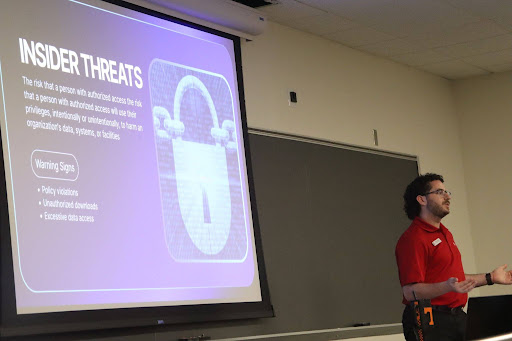
Following lunch, interns walked to the classroom for an afternoon focused on human‑centered cybersecurity and consulting fundamentals. One rotation featured Social Engineering: How to Train Employees, led by Lisa Mathews. Students explored how cybercriminals manipulate trust, urgency, or curiosity to gain unauthorized access, and how organizations can reduce these risks through effective employee training. Interns examined real examples of phishing, pretexting, and impersonation, learning how awareness programs and clear security policies empower employees to act as the first line of defense.

In the parallel session, Phuong introduced interns to Cybersecurity Consulting, guiding them through the process of transforming technical findings into actionable recommendations for nonprofit clients. Students discussed how consultants assess organizational needs, prioritize risks, and communicate solutions in ways that are both technically sound and operationally feasible. The session emphasized clarity, empathy, and strategic thinking—skills essential for supporting organizations with limited resources and evolving cybersecurity challenges.




Comments