_edited.png)
Human-Human Interface: Interns Transfer Muscle Control with Dr. Wurzman
- Marshall Bailly
- Jul 11, 2025
- 2 min read

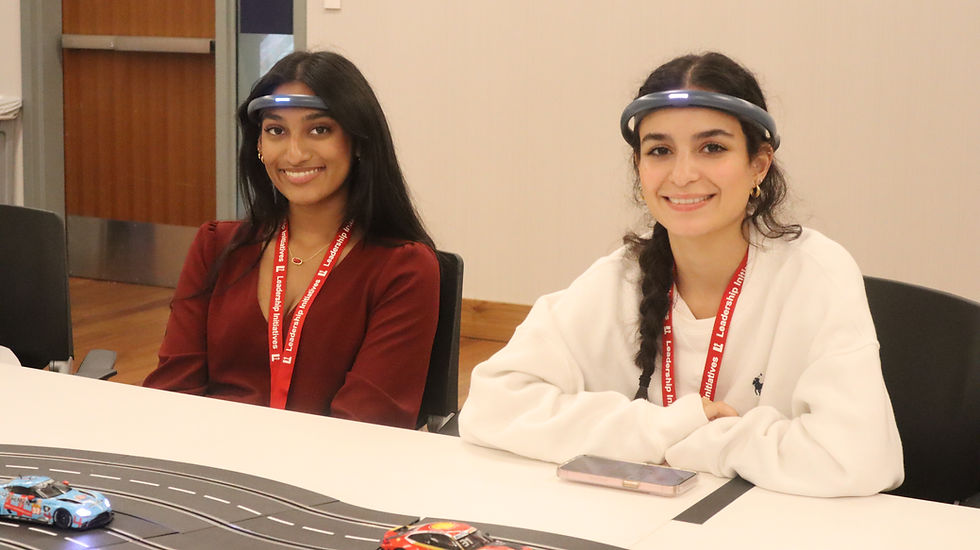
On Thursday, interns stepped into the future of neuroscience with an experiment that felt like science fiction turned science fact. Guided by Backyard Brains’ Human–Human Interface, they explored how electrical signals from one person’s brain could control another person’s muscles: live, and in real time.

The setup was simple: one intern became the “Master,” voluntarily flexing their forearm. The other took on the role of “Minion,” whose arm would move involuntarily, triggered by the Master’s muscle activity. But what looked like a party trick was actually a striking demonstration of how neural signals travel through the body and can be hijacked, rerouted, and shared.

The experiment used electromyography (EMG) to detect activity in the Master’s forearm flexor muscles. When the Master flexed, the system picked up that signal, amplified it, and converted it into a small electrical pulse that was delivered to the Minion’s arm via functional electrical stimulation (FES). Just like that, one person’s intention became another’s action.
But this wasn’t just an electrifying spectacle. It was an invitation to dive deeper into motor neuroscience and the intricate systems that allow us to move.
At the heart of this experiment lies a key question: How does the brain turn thought into movement? The process involves a series of lightning-fast steps:
The motor cortex initiates the movement plan.
Electrical impulses travel down the spinal cord through motor neurons.Peripheral nerves carry the message to specific muscle fibers.
Muscles contract, creating visible movement.
Interns saw how this chain of command could be intercepted. Instead of the Minion’s brain sending the signal to move, the Master’s brain did it for them, revealing just how dependent our movements are on precise neural pathways.
The session also touched on the threshold for stimulation, how much signal was required to trigger a visible muscle twitch, and how different individuals had varying levels of sensitivity. Interns measured latency between the Master’s flex and the Minion’s response, offering a rare chance to quantify the delay between brain activity and muscle activation.
Through this, they began to understand the real-world implications:
How do neuroprosthetics mimic this process for individuals with paralysis?
Could those in a coma communicate with their loved ones?
How can rehabilitative stimulation help stroke patients regain motor function?
What are the ethical considerations of technology that enables one person to control another?
Interns learned that even in such a “fun” experiment, the underlying science is deeply relevant. Disorders like ALS, stroke, and spinal cord injury often involve broken communication lines between the brain and body. Technologies like the Human–Human Interface offer insight into how those lines might be reconnected.
By the end of the session, students had a new appreciation for neural engineering, the emerging field that merges biology, technology, and data to restore or enhance human function. For students eyeing careers in neuroscience, medicine, or biomedical engineering, this lab offered a hands-on look into the future. It wasn’t just about watching a friend’s arm move, it was about understanding the incredible neural circuitry that connects intention, electricity, and motion. And for many, it was their first real encounter with the power of the human nervous system, and how it might one day be rewired.



Comments